 A bright beginning
Early in the 19th
century, the town of Brighton - then known as Brighthelmstone
- had a population of around 7,000. By 1849 this figure had
risen to 60,000 and many of today's familiar places were being
built, including the Royal Pavilion, the Volks Railway, the
Aquarium and the Palace Pier.
Just before 1860, the town council decided that all of
Brighton's wastewater should be drained into the sea. Until
then the sewage and household waste was mostly drained into
cesspools at the back of dwellings - a most unpleasant
arrangement.
At this time very few sewers had been laid. The few that
existed were 22cm (9" in diameter, constructed
of 11cm (4.5") brickwork in lime mortar and called 'gun
barrel' drains.
Some rainwater sewers were constructed of hewn chalk with a
slate bed and discharged directly on the upper part of the
beaches. It was forbidden to connect household drains to them,
although many illegal connections were made and the outfall
pipes were gradually extended further out to sea.
Following detailed surveys by the town council, work began
in 1865 to improve the systems. The old streets were drained
into three outfalls, one at the western boundary, one at the
town centre (Albion) and one using an existing outfall at
Black Rock. Each was provided with an overflow weir which
would operate in times of heavy rain.
About 71km (44 miles) of sewers were laid ranging
from 30cm (12") diameter salt-glazed ware pipes to
2.4m (8ft) circular brick tunnels.
 Public pressure
The inhabitants of
Brighton were not content with this outfall arrangement and,
in 1869, public pressure grew for an intercepting sewer - a
main trunk sewer into which other sewers would drain and which
would take the wastewater outside the town altogether.
When the council officials consulted several engineers they
received a wide variety of proposals, including extensions to
the existing outfalls, an intercepting sewer with an outfall
to the west of the town near the present Hove lagoon, and an
outfall at Saltdean.
Sir John Hawkshaw suggested the scheme which was
subsequently adopted - an intercepting sewer draining into an
outfall at Portobello, which was then nearly four miles east
of the borough boundary.
This generated much controversy locally and it became a
hotly-argued election issue. An Act of Parliament was obtained
in 1870 forming a body called the Brighton Intercepting and
Outfall Sewers Board.
The board accepted a tender of £80,000 from Mr Matthew
Jennings and work began in January 1871. But it stopped in May
when the contractors could not cope with the volume of water
encountered.
The sewer completed
A new contract was
awarded in August to Messrs John Aird and Son and the work was
finally completed in June 1874. The cost to the Board was
£104,608 but Messrs Aird lost £40,000 because they too had
trouble with the amount of water encountered.
Thirteen pumps of 51cm(20") diameter were driven by
nine engines to pump an estimated 68 million litres (15
million gallons) every 24 hours. The resulting intercepting
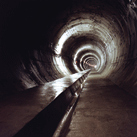
sewer is circular, made of brickwork, 1.5m (5ft) in diameter
from Hove Street to East Street and 2.1m (7ft) thereafter to
Portobello at Telscombe - a total of 11.5km (7.25 miles).
At the Old Steine and Black Rock storm water overflows were
built. Catchpits were built to collect road grit and heavy
stones, and these need frequent clearing. Today this work is
carried out late at night when the sewer flow level is low.
The grit is dug out by hand and winched up into a skip lorry
above ground and taken away. Sixty ventilating shafts were
built along the length of the sewer, and these also provided
means of access for workers.
Two storm sewers both 2.4m (8ft) in diameter were
constructed at a later date to take any excess flow caused by
excessive rainfall in the catchment area.
Subsequent improvements
In 1885 an
additional ventilator was added to the system at Rottingdean,
incorporating a building which was a replica of the many
coastguard cottages at that time. Many years later, this was
demolished and a modern bungalow put up in its place.
Another shaft, built in 1876, was topped with a chimney
standing 31m (102ft) above the cliff top at Roedean. A coke
furnace was kept burning 24 hours a day to draw a continuous
flow of air through the sewer. The chimney was demolished in
1933.
At Rottingdean High Street the sewer is 15.2m (50ft) below
ground and receives the wastewater of Rottingdean by way of a
catch tank. Up to this point the sewer has a gradient of one
yard per mile (91cm per 1.6km), but from here to Portobello
the gradient is one foot per mile (30cm per 1.6km).
As Brighton and Hove continued to expand, the sewerage
system was extended to include new streets.
Following a severe rainstorm in 1892, it became obvious
that some of the trunk sewers would have to be enlarged and a
scheme costing £25,000 was implemented. Repairs were also
carried out to the Kings Road sewer which was described as
being old, although the original construction date was not
known. Serious flooding also occurred along Lewes Road and
this prompted the construction of the relief sewer in
1929.
This, then, is the trunk sewer system still in use today.
As the urban area has expanded so has the sewer system - 482km
(300 miles) of main sewers now exist beneath Brighton and
Hove.
Since the early 1960s, tours of the magnificent Victorian
sewers have been held from May to September. For safety
reasons children under 11 and people who may find the
underground ladders difficult to manage are not permitted.
 Responsibility for the operation and maintenance of
the sewers passed from the Brighton and Hove Intercepting and
Outfall Sewers Board to the Southern Water Authority following
the Water Act of 1973, then in 1989 to Southern Water as part
of the privatisation of the water industry.
Responsibility for the operation and maintenance of
the sewers passed from the Brighton and Hove Intercepting and
Outfall Sewers Board to the Southern Water Authority following
the Water Act of 1973, then in 1989 to Southern Water as part
of the privatisation of the water industry.
Meeting today's requirements
The
Victorian intercepting sewer still forms the backbone of
today's sewerage system in Brighton and Hove - a wonderful
tribute to the design and workmanship of those early
engineers.
But modern requirements - particularly in avoiding
pollution through storm overflows and sea water
outfalls - mean that extensive work has to be undertaken
to keep the system up to date.
For example, Southern Water has built Europe's largest
stormwater storage tunnel, 4.8km (3 miles) long, 6m (20ft) in
diameter and 30m (100ft) under the seafront at Brighton and
Hove, to stop pollution during storm conditions.
 This work is bringing significant improvements to
the quality of the bathing water along the Sussex coastline
and these improvements will continue in the years to come.
This work is bringing significant improvements to
the quality of the bathing water along the Sussex coastline
and these improvements will continue in the years to come.
So, in Brighton and Hove, a combination of Victorian
ingenuity and modern technical knowledge is providing one of
Europe's most efficient sewerage systems.

